Home › Services
Fence installation in Fort Wayne, from the first stake to the last latch
A new fence looks simple from the street: posts, rails, boards, a gate. The work that decides whether it still stands straight after ten winters happens before a single picket is hung. In Fort Wayne and the rest of Allen County that means pinning down where the lot actually ends, getting buried utilities marked, clearing the right approvals, and digging into slow-draining clay that frost loves to shove around. This page walks through the job in the order it really happens. Material choice is its own question, covered on pages like wood privacy fences; here the focus is the process, so you can judge a proposal and know what a careful installer does that a hurried one skips.
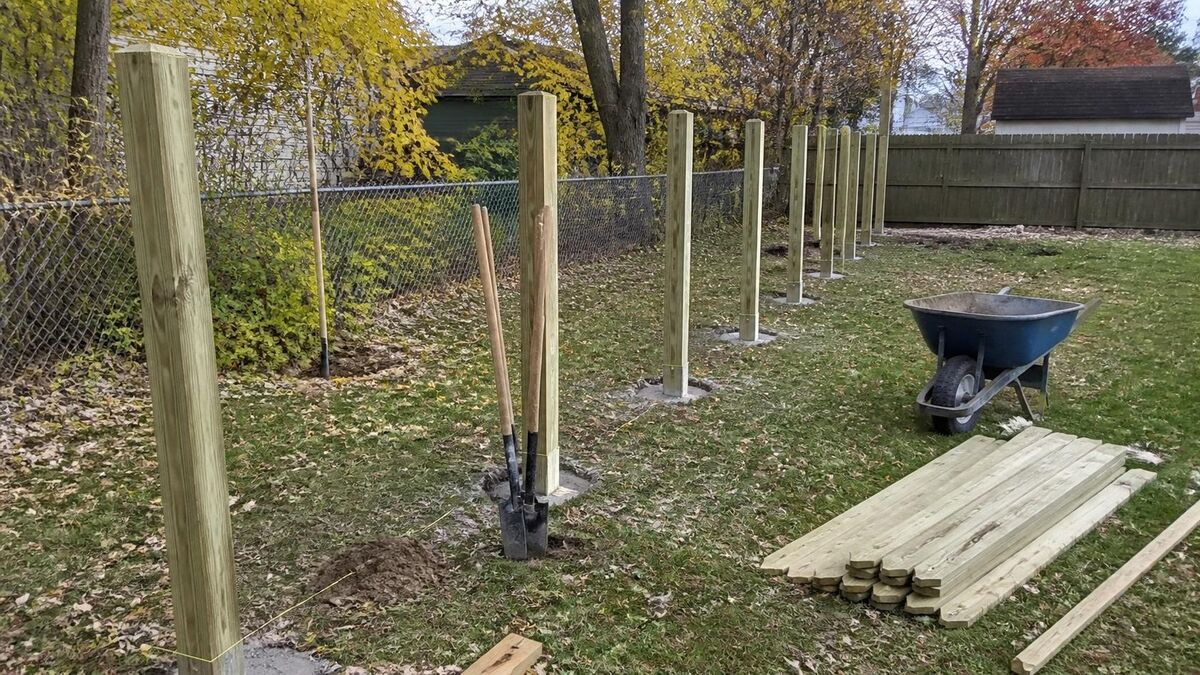
Finding the true property line before anything is staked
The costliest fence mistake is one built a foot onto the neighbor's ground. Fixing it means tearing out and resetting the run, and sometimes a strained relationship that outlasts the fence. So the line comes first, and it should come from something better than where the mowing stops.
Many Allen County lots, especially in subdivisions platted over the last few decades, still have iron pins or capped rods buried at the corners. A metal detector and a thin probing rod will often turn them up a few inches below the sod. Closing paperwork may include a plot plan, which helps, but those drawings are not always precise enough to fence against. When pins are missing or neighbors disagree, the clean answer is a boundary survey from a land surveyor, and a good installer will say so instead of eyeballing it.
- Hunt for corner pins before the estimate visit and flag any you find.
- Have any plat, survey or plot plan from your closing documents ready to show.
- Decide whether to hold the fence slightly inside the line so both faces can be maintained from your side.
- Talk with the neighbor early about placement and which face points outward.
Indiana 811 and the buried lines you cannot see
Every post hole is a small excavation, and backyards in Greater Fort Wayne hide gas service, buried electric, cable, fiber and sometimes an old pet containment wire. Indiana 811 is the free call-before-you-dig service, and a locate request is the normal first step before digging day. Public locates stop at the meter, though. A line you own past that point, feeding a detached garage, a grill, landscape lights or sprinklers, will not be marked, so point those out during the walk.
- The locate request goes in a few working days ahead, describing the full fence route.
- Utility owners mark their lines with colored paint or flags across the work area.
- The installer compares the marks to the layout and shifts any post that lands too close.
- Holes near a mark are opened by hand rather than with a powered auger.
Permits, zoning reviews and homeowners association approvals
Who signs off depends on exactly where the house sits. An address inside Fort Wayne city limits answers to the city's zoning rules, while a home in unincorporated Allen County or a separate town such as New Haven or Huntertown may answer to another office. Those rules usually address front-yard versus back-yard height, visibility at corners and driveways, whether a permit is needed, and what can be built over drainage or utility easements. The figures belong to the local planning or building office, so confirm them for your address rather than copying what a neighbor did.
Subdivisions add a second layer. Many neighborhoods carry recorded covenants restricting material, color, height or style, and an architectural committee often wants a drawing and a product sheet before work begins. That submission belongs at the front of the schedule, and nothing should be dug until approval is in hand.
Digging post holes in heavy northeast Indiana clay
Much of the Fort Wayne area sits on dense clay left by glacial lakes and ice. It holds water, drains slowly and swells as it freezes. In a hard northeast Indiana winter frost works well down into that soil, and a post whose base sits inside the frozen layer gets gripped and lifted a little more each year. The bottom of the hole has to sit beneath that zone, and the depth your building department expects is something to confirm with them, not guess at.
Diameter matters as much as depth. A narrow hole leaves a thin collar of concrete that cracks or lets the post wobble, while a hole flared wider at the bottom gives frost less of a smooth face to push on. Clay spoils come out heavy and sticky, so a tidy crew plans where that dirt goes. Buried debris and old footings from a previous fence turn up often on older lots and can force a post to move a few inches.
Concrete, gravel or foam: choosing how the posts are set
Once a hole is open, the post has to be locked in. Installers in this region disagree in good faith about the best method, and what matters is that it suits the material, the soil and the load.
- Concrete footings are standard for privacy fences and gate posts. The top should be crowned so water sheds off, and a few inches of gravel underneath helps a clay hole drain.
- Tamped gravel or crushed stone, compacted in lifts, keeps water from collecting around a wood post and makes a future replacement far easier.
- Expanding post foam is fast and light but offers less mass against frost and wind, so ask whether your fence manufacturer accepts it.
- Chain link terminal posts and ornamental aluminum posts are usually set in concrete, and vinyl systems often specify their own method, which should be followed.
Handling slopes and uneven ground: stepping versus racking
Allen County is mostly flat, but almost no yard is truly level. Swales carry water through back lots, ground falls toward a pond or creek, and new construction often leaves a grade change near the house.
Stepping keeps each section level and drops it in a stair pattern, which suits rigid panels but leaves triangular gaps under the low ends. Racking tilts the rails to follow the slope, keeping the bottom close to the ground. Wood and chain link rack easily, many aluminum systems come in rackable versions, and most vinyl panels rack only a little. Whatever the approach, the fence must never dam a swale that was graded to move water.
Gate framing, hinges, latches and swing direction
Gates take more abuse than anything else on a fence and show sloppy work first. A gate is a lever hanging off one post, so the hinge post should be heavier or set deeper and wider than a line post. A wood gate needs a diagonal brace running from the bottom hinge corner up toward the latch side so the frame resists sagging, and wide double drive gates usually add a drop rod to hold the inactive leaf.
Plan each opening around how you will use it. A gate that must pass a riding mower or trash cart needs clear width with room to spare, and one that swings uphill will scrape. Hardware should be sized to the gate's weight and finished to resist rust. If the fence encloses a pool, barrier rules shape the gate, and the aluminum fence page explains what those rules cover.
Removing the old fence and hauling the debris away
Many installations start with a teardown. Panels come off fast, but old concrete footings in clay are big and stubborn, and pulling them can take a jack or small machinery. Some installers cut old posts at grade and set new ones beside them, which is quicker but leaves buried concrete in the way of future digging.
Ask how removal is priced, whether old material leaves the same day, and who arranges a dumpster. Treated wood should not be burned, so disposal belongs in the plan. If much of the existing fence is still solid, a fence repair visit may make more sense than a full tear-out.
The usual installation sequence and a realistic timeline
Schedules shift with season, approvals and material availability, so no honest installer promises a date at the first visit. Spring and early summer are busy across northeast Indiana, and saturated clay can push digging back after heavy rain. The order of the work stays consistent.
- Site visit, measurements and a talk about use, material, height and gates.
- Written proposal, your approval and a signed agreement.
- Permit or association submission where required, then waiting on the answer.
- Material ordering, quick for stock wood or chain link and slower for specific vinyl or aluminum styles.
- Locate request and marking of the route.
- Digging and post setting, the most labor-heavy day of the job.
- A pause for poured footings to firm up before rails add load.
- Rails, boards, panels or fabric installed, gates hung and adjusted, spoils removed and a final walk of the line with you.
What a complete fence installation quote should spell out
Two proposals for the same yard can look far apart until you read what each includes. The main cost drivers are total length, height, material and style, the number and width of gates, how many corners and ends the layout has, slope, soil and equipment access, and whether removal is included. The contractor prices the job after seeing it, and a complete quote shows the yard was actually measured.
- A drawing or description of the route with length, height and each gate's location and width.
- The exact material, grade and style, with post size, post spacing and fastener type.
- How posts will be set, noting that the building department's depth requirement governs.
- Who handles the permit, association approval and locate request.
- Removal, haul-away and handling of hole spoils, plus how buried obstructions are dealt with.
- Payment schedule, an approximate scheduling window and written workmanship coverage terms.
Getting a fence installation started in Allen County
A little homework speeds everything up: find corner pins, gather your survey, read your covenants and decide which gates you need. Then send the address, a rough sketch of the run and a few photos through the contact page, and the request goes to a residential fence contractor working Fort Wayne and nearby towns. You can also see how local lots shape the work on the service area pages.
Fence Installation: questions people ask
How deep do fence posts need to be in Fort Wayne?
Deep enough that the bottom of each post or footing sits below the frost line, and the local building department for your address is the authority on that figure. Allen County clay freezes hard and holds water, so a post that stops short gets lifted a little every winter. Gate posts and end posts carry more load and are often set deeper and wider than line posts. Ask any installer to put the planned hole depth and diameter in the written proposal.
Will the fence installer remove my old fence?
Many will, but it is rarely automatic, so it should appear as its own line in the proposal. Removal involves pulling panels and posts, breaking out old concrete footings, and hauling everything away, and old footings in clay can be large. Some installers cut old posts at ground level instead, which is faster but leaves concrete that may block new holes along the same route. Ask which approach is planned and whether disposal of treated wood and scrap metal is included.
How long does it take to install a new fence?
On-site work for a typical backyard often runs a matter of days, but the full calendar is longer because of steps that come first. Approvals from a city office or homeowners association take time, certain vinyl or aluminum styles may need ordering, utility locates require advance notice, and poured footings need time to firm up before rails carry weight. Wet clay after heavy rain can also delay digging. Ask for an approximate window in writing rather than a fixed promise.
Is it better to set fence posts in concrete or gravel?
Both work when done properly, and the right choice depends on the material, the load and your soil. Concrete gives the most rigidity and is the usual pick for gate posts and privacy fences, provided the top is crowned to shed water and gravel beneath drains the hole. Tamped gravel drains well in wet clay and makes later post replacement easier, but it needs careful compaction. Either way, the hole must reach below frost depth as your local building department defines it.
What should a fence installation quote include?
At minimum: the total length and height, the route with every gate marked and its width, the specific material and style, post size and spacing, and how posts will be set. It should state who handles approvals and the utility locate request, whether old fence removal and haul-away are included, and how rock or buried debris found during digging will be treated. Payment terms, an approximate scheduling window and written workmanship coverage round it out. Missing items make two bids impossible to compare.
Who calls 811 before a fence is installed, me or the contractor?
Either can place the request through Indiana 811, and the service costs nothing. Many fence contractors handle it as part of the job, but confirm who is responsible in the written proposal so nobody assumes the other did it. Utility locates only mark lines up to the meter. Private lines you own, such as wiring to a shed, a gas line to a grill or sprinkler pipe, are not marked, so point them out during the estimate visit.
Talk through your site
Start with the address, what you want done, and a few photographs of the area, including anywhere water sits after a heavy rain.
Related work
Fence Repair
Heaved and leaning posts, dragging gates, storm damage and rot, and when a repair stops making sense.
Wood Privacy Fences
Board-on-board, shadowbox and stockade privacy fences, and what makes wood last through an Indiana winter.
Vinyl Fences
Low-maintenance vinyl privacy and picket fences, and how they hold up in deep cold and open wind.
Chain Link Fences
Galvanized and black-coated chain link for dogs, kids and back property lines.
Aluminum & Ornamental Fences
Ornamental aluminum for front yards, pool enclosures and lots that do not sit flat.
Across the metro
Aboite
Southwest-side subdivisions, wooded lots, lakes and ponds, and association rules on height and style.
Huntertown
Fast-growing north-side neighborhoods on flat, freshly graded lots with slow drainage.
New Haven
An older town grid east of the city plus newer edges, mixed fence vintages and replacement work.
Leo-Cedarville
Larger lots and acreage along the Cedar Creek valley, with long runs, grade and tree lines.