Home › Services
Wood privacy fences in Fort Wayne, built to outlast clay, frost and wind
A wood privacy fence is still the most common backyard enclosure across Fort Wayne, and for good reason: it blocks sight lines completely, it can be shaped to almost any lot, and it looks like it belongs next to a house. It is also the fence type that rewards good decisions most and punishes shortcuts fastest. The species of lumber, the treatment rating stamped on the posts, the board pattern, the post size, the screws and the first coat of stain all decide whether the fence stands straight for many seasons or starts to lean, gray and split after a few. This page walks through those choices for Allen County soil and weather, so you know what to ask for before a contractor writes the proposal.
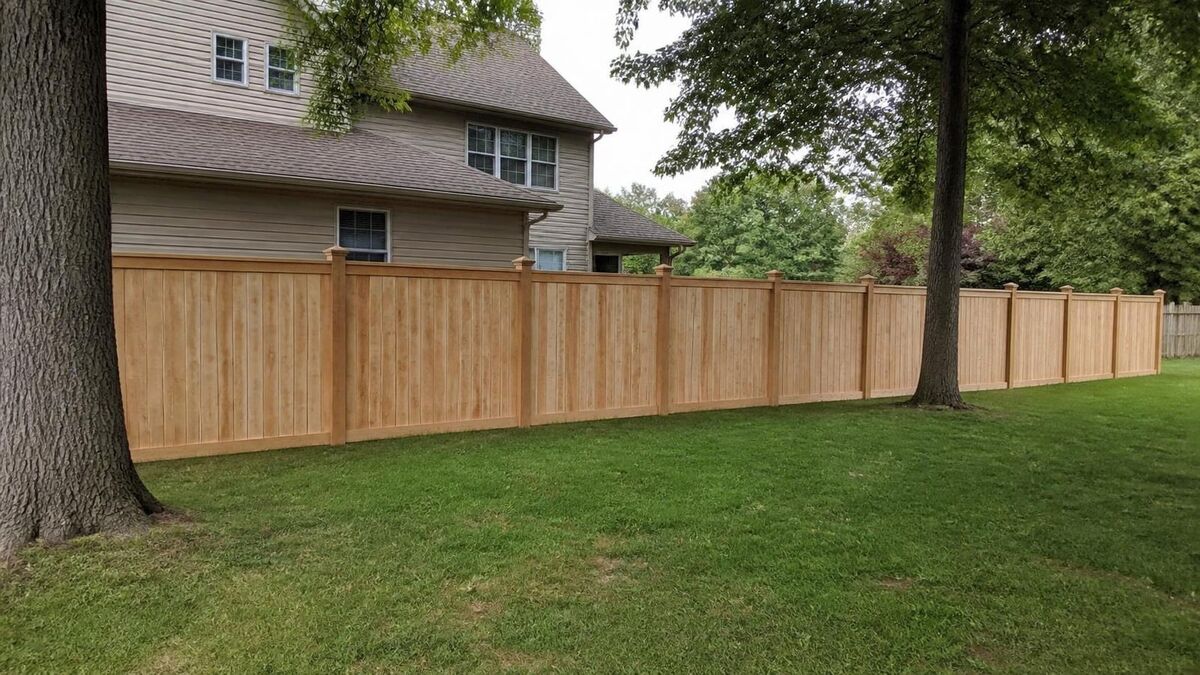
Treated pine or cedar: the first real decision
Most wood privacy fences in northeast Indiana are built from one of two materials. Pressure-treated southern yellow pine is dense, strong and widely stocked. It arrives wet and greenish or brown from the treatment plant, and it shrinks as it dries, which is why fresh pine boards often open small gaps during their first summer.
Western red cedar and similar cedars are lighter, more stable and naturally resistant to decay and insects because of oils in the heartwood. It warps less than pine and weathers to a soft silver if left alone. It is also softer, so it dents more easily and holds fasteners a little less tightly. A very common Allen County combination is treated pine posts and rails carrying cedar pickets, which puts the strongest, most rot-resistant material in the ground and the prettiest, most stable material on the face.
Why the ground-contact rating stamped on a post matters so much
Treated lumber is sold under different use categories, and the tag stapled to the end of each piece tells you which one it meets. Lumber rated for above-ground use has absorbed less preservative than lumber rated for ground contact. Both can look identical in the store. The difference shows up years later, when an above-ground board that was used as a post turns soft and punky right at the soil line.
For any post that goes into the earth, ask for lumber rated for ground contact, and for posts set in wet, heavy clay, ask whether the yard calls for the heavier in-ground rating some suppliers carry. Cut ends matter too. When a post is trimmed to height or a rail is cut to length, the fresh end exposes untreated heartwood, and a good installer brushes an end-cut preservative onto it. Cheap jobs often skip that step.
Board patterns: stockade, board-on-board, shadowbox and horizontal
The board pattern changes how private the fence is, how it handles wind, how much lumber it uses and how it looks from each side. The common choices:
- Stockade: boards butted edge to edge, often with dog-ear or pointed tops, usually built in prefabricated panels. It is the most economical solid fence, but as pine boards shrink, thin gaps open between them.
- Board-on-board: a first layer of boards with spaces between them, then a second layer that overlaps the gaps. It stays fully private even after the wood shrinks, looks finished from both sides and uses noticeably more lumber.
- Shadowbox: boards alternate on opposite sides of the rails with a small gap, so a breeze can pass through while a straight-on view is blocked. Neighbors see the same face you do, which helps on shared lines.
- Horizontal: boards run sideways between posts for a modern look. Long horizontal boards sag unless the posts are closer together or a center support is added, so this style needs more structure than it appears to.
- Cap and trim: a flat cap board across the post tops and a trim strip under it. It sheds rain off the end grain, stiffens the top of the fence and makes a plain fence read as custom work.
Post size and spacing for a solid fence
A solid wood fence behaves like a sail. Every board catches wind, and that load travels down to the posts and into the ground. Newer open subdivisions on the flat ground around Fort Wayne get long, unbroken gusts, and a tall privacy fence there takes far more strain than one tucked behind a wooded lot.
Posts are commonly spaced around eight feet apart, matching standard panel and rail lengths, though many builders tighten that span on tall solid fences or exposed runs. Line posts in light-duty work are often four-by-four lumber, while gate posts, corners, ends and tall sections benefit from six-by-six stock, which resists twisting and bending far better. Three rails rather than two is the usual recommendation on a tall fence, because the middle rail stops boards from bowing and keeps the panel square. Ask the contractor what post size and spacing they plan and why, especially for the side of the yard that faces open ground.
Holding up to Allen County clay and frost
Much of the Fort Wayne area sits on heavy clay left by old glacial lakes and ice. That clay holds water long after a rain, drains slowly and expands when it freezes. Winter frost reaches well down into the ground here, and when wet clay freezes around a post, it can grip the post and lift it a little each season. That is frost heave.
The defense is a hole that goes below the depth frost reaches, with a shape and backfill that let the soil slip past the post rather than grabbing it. Your local building department sets the depth required for the address, and a careful contractor digs to that figure, not to a habit. The full setting process is laid out on the fence installation page. For a wood fence specifically, ask whether the post bottom will sit on gravel so water drains away from the end grain instead of pooling in a concrete cup.
Fasteners, hardware and corrosion
Modern treated lumber uses copper-based preservatives, and copper is hard on plain steel. Bright or electro-plated nails and screws can corrode quickly when driven into fresh treated pine, leaving rust streaks down the boards and, eventually, pickets that pull loose. The fix is simple: use hot-dip galvanized or stainless fasteners rated for treated lumber. Stainless is the better match for cedar, whose tannins can blacken around ordinary steel.
Screws hold better than smooth nails as boards shrink and swell through the seasons, and ring-shank nails are a reasonable middle ground for production work. Gate hinges and latches should be galvanized or powder-coated and sized for a solid wood gate, which weighs more than most people expect. A solid proposal names the fastener type and the gate hardware instead of leaving them blank.
Staining and sealing: when to start and how often to repeat
Unfinished wood absorbs rain, dries in the sun and absorbs rain again. Wet-dry cycling drives cupping, checking and splitting, and it gives mildew a foothold on the shaded north faces of a fence. A penetrating stain or water-repellent sealer slows that cycle and blocks some of the sunlight that grays the surface.
Timing depends on the wood. Fresh treated pine is too wet to accept a finish at first and needs a good stretch of warm, dry weather. Kiln-dried lumber and cedar can be finished much sooner. Once the first coat is on, expect to refinish on a cycle of a few years, with the south- and west-facing runs needing it earlier because they take the most sun.
- Clean the boards with a wood cleaner or a gentle wash to lift dirt, mildew and gray surface fibers. Avoid blasting the wood with a narrow high-pressure tip, which raises fuzz and gouges soft cedar.
- Let the fence dry for a couple of days of warm weather so the stain can penetrate rather than sit on top.
- Apply a penetrating oil-based or water-based stain by sprayer, roller or brush, then back-brush to work it into the grain and the board edges.
- Watch the forecast. Rain or a cold night within the first day can leave the finish blotchy or soft.
How a wood fence fails, and what slows each problem down
Wood fences tend to fail in predictable places. Knowing them helps you judge a design before it is built and spot trouble early once it is up.
- Rot at the soil line, where posts stay wet and oxygen is present. Proper ground-contact lumber, a drainage base and a sloped concrete or soil crown at the top of the hole all help.
- Rot on top of posts and in rail joints, where water sits on end grain. Post caps, cap boards and sloped cuts shed it.
- Boards pulling loose or cupping, usually from undersized or corroded fasteners and wide boards drying unevenly.
- Gates dragging, caused by heavy frames without a diagonal brace running from the bottom hinge corner up to the top latch corner.
- Leaning sections after a windy winter, which point back to post size, spacing and depth in exposed spots.
- Mildew and moss on shaded faces and on boards touching soil, mulch or snow piles. Keeping the bottom edge an inch or two off the ground matters more than most people think.
What drives the cost of a wood privacy fence
No two wood fences cost the same, and an honest number only comes after someone walks the yard. These are the factors that move the figure most, so you can see where your choices land:
- Total length and height, plus how many corners and ends break up the run.
- Species and grade: treated pine, cedar, or a mix of the two, and whether the boards are knotty or clear.
- Board pattern. Board-on-board and shadowbox use more lumber and more labor than stockade panels.
- Post size and spacing, the number of rails, and whether cap and trim are included.
- The number and width of gates, and whether a wide drive gate needs a steel frame or double leaves.
- Yard access, grade changes, tree roots, buried rock and removal of an old fence.
- Whether staining is part of the job now, or left for later once the wood dries.
Wood, vinyl or something more open?
Wood wins on natural look, on how easily it can be cut to fit an odd lot and on how simple it is to replace one broken board. It asks for more upkeep than other materials. If you would rather never stain anything, the vinyl fence page explains how a well-made vinyl privacy fence handles the same climate, and the fence repair page is the right stop if you already have a wood fence that is leaning or rotting. Lot sizes, slopes and association habits differ from one community to the next, and the service areas page breaks those down. When you are ready to price a new one, send the address and a few photos of the yard, and the contractor can take a look and scope it.
Wood Privacy Fences: questions people ask
How long does a wood privacy fence last in Indiana?
Life span varies more with how the fence is built and kept than with the calendar. Ground-contact posts set in a well-drained hole, quality boards, corrosion-resistant screws and a stain renewed every few years can keep a wood fence sound for a long time. Above-ground lumber used as posts, posts sitting in water, and boards that are never finished can fail much sooner. In heavy Allen County clay, drainage at the post base is usually the deciding factor, because the soil line is where most wood fences give out first.
Is cedar worth it over pressure-treated pine for a fence?
Cedar is worth it if you care about stability and appearance on the face of the fence. It warps and cups less than pine, takes stain evenly and resists decay without chemical treatment. Pine is stronger and better suited to posts, especially in the ground. Many homeowners split the difference: treated pine posts and rails for structure, cedar boards for the visible face. Ask for both options priced side by side on your fence length.
Should the good side of a wood fence face my house or my neighbor?
Common courtesy, and many association rules, put the finished side facing outward toward the neighbor or the street, with the posts and rails on your side. Some local rules require it, so check the covenants before building. If you want a clean face on your side too, board-on-board and shadowbox styles look nearly the same from both directions. They cost more in lumber but settle the question.
How soon can I stain a new pressure-treated fence?
Wet treated pine needs time to dry before a finish will soak in. A simple test helps: sprinkle water on a board. If it beads and sits on the surface, the wood is still too wet. If it darkens the board and absorbs within a few minutes, the fence is ready. In a Fort Wayne summer that can take weeks to a few months depending on sun and shade. Lumber dried after treatment can be finished sooner.
Why are there gaps opening between my new fence boards?
Treated pine leaves the plant soaked with water and preservative, and it shrinks across its width as it dries. Boards installed tight against each other in spring can show thin gaps by late summer. That is normal wood behavior, not a defect. If full privacy matters, ask for a board-on-board pattern, where the second layer covers the seams, or for boards installed with a small overlap. Cedar shrinks less, so it is another way to limit the effect.
Do wood fence posts need concrete in clay soil?
Not always, and in clay it is a real debate. Concrete locks a post firmly but can trap water around the base if the bottom is sealed, and wet clay can grip a smooth concrete plug during a freeze. Many builders set wood posts on a gravel base with concrete above it, crowned at the top so rain runs away. Others use compacted gravel alone for drainage. Either way, the hole must go below the frost depth your building department requires for the address.
Talk through your site
Start with the address, what you want done, and a few photographs of the area, including anywhere water sits after a heavy rain.
Related work
Fence Installation
New residential fences laid out, set and finished for northeast Indiana frost and heavy lake-plain clay.
Fence Repair
Heaved and leaning posts, dragging gates, storm damage and rot, and when a repair stops making sense.
Vinyl Fences
Low-maintenance vinyl privacy and picket fences, and how they hold up in deep cold and open wind.
Chain Link Fences
Galvanized and black-coated chain link for dogs, kids and back property lines.
Aluminum & Ornamental Fences
Ornamental aluminum for front yards, pool enclosures and lots that do not sit flat.
Across the metro
Aboite
Southwest-side subdivisions, wooded lots, lakes and ponds, and association rules on height and style.
Huntertown
Fast-growing north-side neighborhoods on flat, freshly graded lots with slow drainage.
New Haven
An older town grid east of the city plus newer edges, mixed fence vintages and replacement work.
Leo-Cedarville
Larger lots and acreage along the Cedar Creek valley, with long runs, grade and tree lines.