Home › Services
Vinyl fences in Fort Wayne that stay white, straight and whole through winter
Vinyl appeals to Fort Wayne homeowners who want a clean, finished fence and never want to pick up a stain brush again. A good vinyl fence delivers that. A poor one cracks the first time a snowblower flings ice at it, chalks and yellows in the sun, and lets its gates droop within a couple of seasons. From the curb, the two can look almost identical on install day. The differences hide inside the material: the resin recipe, the thickness of the walls, how the rails lock into the posts and whether metal is hidden where the load is heaviest. This page explains what to look for, so you can tell a lasting product from a bargain one before the proposal is signed.
What vinyl fencing actually is
Residential vinyl fence is extruded polyvinyl chloride, or PVC, pushed through a die to form hollow posts, rails and pickets. The formulation matters as much as the shape. Quality fence profiles add impact modifiers that keep the plastic from shattering, and titanium dioxide near the surface that shields the resin from ultraviolet light. Some manufacturers make the profile from one uniform compound throughout. Others co-extrude, putting a weather-resistant outer skin over a different inner core.
Neither approach is automatically better. What counts is that the outer surface carries enough UV protection for years of direct sun and that the whole profile stays tough in cold weather. Reputable manufacturers publish their product specifications and test results, and a contractor offering a premium line should be able to name the brand and the profile series rather than calling it simply white vinyl.
Wall thickness and what cheap vinyl looks like up close
Wall thickness is measured in thousandths of an inch, and it varies widely between economy and premium products. Thin walls save the manufacturer material, and you feel the savings: a picket that flexes easily under a thumb, a rail that bows between posts, a post that rings hollow when tapped. You do not need a caliper to spot the warning signs.
- Press the middle of a rail or a privacy board. Quality profiles feel rigid; flimsy ones dent or oil-can under light pressure.
- Look at a cut end. Thick, even walls and internal ribs or webbing signal a stronger extrusion.
- Check the surface. A slightly glossy, uniform finish is normal. Streaks, ripples or a chalky film on new stock are not.
- Lift a gate. A well-built vinyl gate feels solid and heavy for its size because of the metal frame inside.
- Ask for the post size. Five-inch posts are a common standard for privacy runs, and four-inch posts belong on lighter picket or rail work.
Cold-weather brittleness and impact in a northeast Indiana winter
PVC gets stiffer as the temperature drops. On a bitter January morning, a rigid vinyl panel absorbs a sharp blow far less gracefully than it would in July. The usual culprits around Allen County are thrown chunks of ice from a snowblower, a sled or a hockey stick, a car door or a trash bin cart caught by the wind, and the edge of a plow pile shoved against the bottom rail.
Better formulations hold up noticeably better to cold impact, which is the main reason premium vinyl costs more. You can also design around the risk. Leave room between the fence and the spot where snow gets piled, set the bottom rail high enough to clear drifted snow along the driveway, and steer clear of running a thin picket fence right beside a spot where a plow turns around. When a section does crack, the fix usually means replacing the damaged piece, a job described on the fence repair page.
Sun, color and why white is the safe choice
Ultraviolet light attacks the surface of PVC over time. Poor-quality vinyl responds by chalking, a dusty white residue that rubs off on a hand, or by yellowing on the sunny faces. Quality vinyl keeps its color for a long time because the UV inhibitors are concentrated where the light hits.
White, almond and light tan are the most forgiving colors, because pale surfaces reflect heat and show fading least. Darker colors, wood-grain textures and two-tone profiles look striking but absorb more heat, which increases expansion and can reveal uneven fading on the south side of a yard. If you want a darker or textured fence, ask how the manufacturer stabilizes the color and whether the darker shade is a coating or color throughout the material.
Routed rails, panel systems and how a vinyl fence locks together
Most vinyl fences rely on routed posts: rectangular holes are cut into the post walls, and the rails slide into them. Locking tabs or small screws keep the rails from backing out. In a privacy style, interlocking tongue-and-groove boards drop into a channel in the bottom rail, then the top rail caps them, forming a tight, solid panel with no visible fasteners.
That design is clean and quick to assemble, but it leaves little room for error. Posts must be set at the exact spacing the panel requires, plumb and in line, because the panel cannot be trimmed or stretched the way a wood fence can. On a lot that slopes, sections are usually stepped down rather than following the grade, since rigid vinyl panels do not rack much. A quality install keeps the steps even and the gaps under each panel consistent, and the general approach to grade is covered on the fence installation page.
Aluminum reinforcement in gates, long rails and windy runs
A hollow plastic rail is not strong enough to carry a tall privacy panel across a long span or to hold a gate square for years. Quality systems hide metal where the load lives. Here is where reinforcement belongs:
- Bottom rails on privacy panels, where an aluminum channel keeps the infill boards from pushing the rail into a sag.
- Gate frames, which should have an internal aluminum frame or at least reinforced rails and stiles, plus a diagonal brace or a frame engineered without one.
- Gate posts, often filled with an aluminum or steel insert, sometimes with concrete inside the post to stiffen it against the swing load.
- Wide spans and exposed sides of the yard, where open wind across flat Fort Wayne subdivisions loads the panel hard.
- Hinges and latches made for vinyl, usually stainless or powder-coated, with through-bolts rather than short screws into hollow plastic.
Expansion and contraction: why vinyl needs room to move
PVC expands noticeably as it warms and shrinks as it cools, much more than wood does. Between a hot August afternoon and a frozen February night, a long vinyl rail changes length enough to matter. Manufacturers build that movement into the design with rails that sit loosely in the routed holes and with specific gaps at panel ends.
Problems appear when an installer ignores that allowance. Rails cut too long or screwed rigidly at both ends can bow outward in summer, pop out of the posts in winter or crack at a fastener. Hardware screwed tight through a gate frame into a post can tear the hole as the plastic moves. Ask the contractor whether they follow the manufacturer's assembly instructions for gaps, and look for rails that sit snug but not jammed when you inspect the finished fence.
Vinyl fence styles that suit Allen County homes
Vinyl comes in more shapes than most people expect. The common residential options include:
- Full privacy: tongue-and-groove boards between a top and bottom rail, the most popular backyard choice for screening neighbors and containing pets.
- Semi-privacy: alternating boards or spaced pickets that let some air and light through while blocking most of the view, which can reduce wind load.
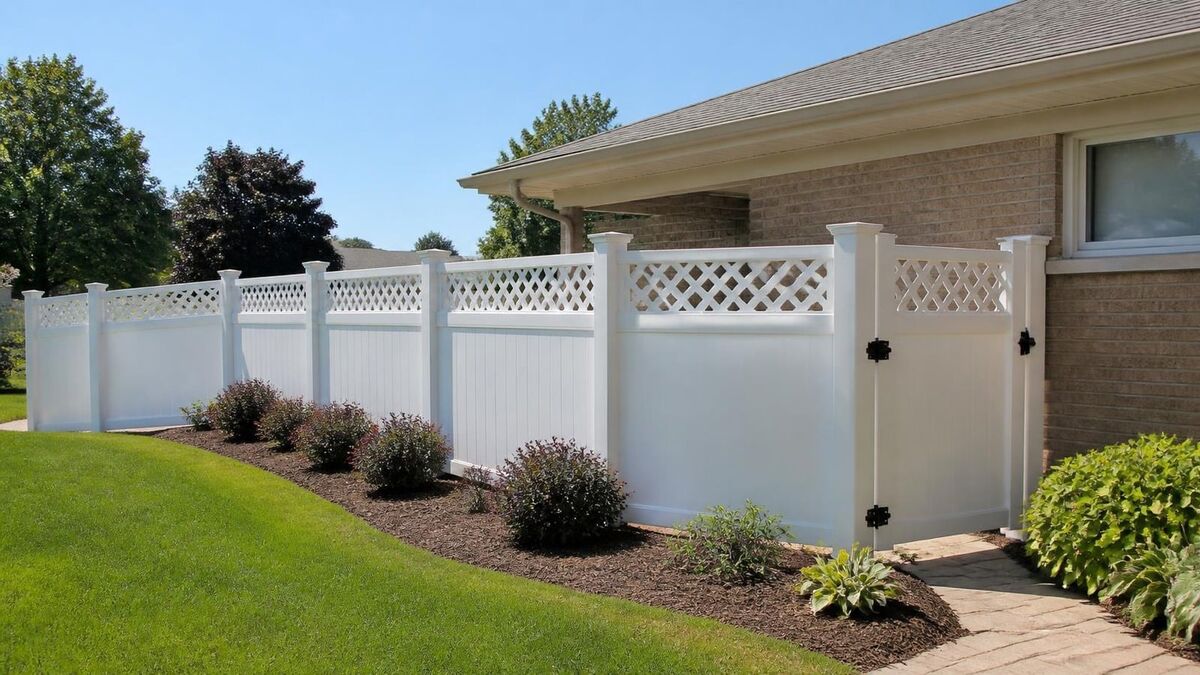
- Privacy with lattice top: a solid lower panel topped with a short lattice or spindle band that softens the look of a tall fence.
- Picket: classic spaced pickets at a lower height for front yards, gardens and decorative edges, available with flat, pointed or scalloped tops.
- Post and rail: two, three or four horizontal rails, often called ranch rail, for marking boundaries on larger lots or keeping horses, with wire mesh added if dogs need containing.
Cleaning and upkeep: easier than wood, but not zero
Vinyl never needs paint or stain, but it does collect dirt, pollen, spider webs and green algae, especially on shaded faces and on the bottom rail where lawn sprinklers and mower clippings hit it. A once-a-year wash keeps it looking new.
- Rinse the fence with a garden hose to knock off loose dust and grass.
- Scrub with a soft brush or sponge and a mild soap and water solution, working from the bottom up to avoid streaks.
- For mildew or algae, use a cleaner made for vinyl siding or fencing, following the label, and rinse well afterward.
- Avoid abrasive pads, harsh solvents and a narrow high-pressure washer tip, all of which can scratch or dull the surface.
- Walk the line each spring to check that rails are seated, caps are on, and gates still latch after the winter freeze.
Repairability: what can and cannot be fixed on a vinyl fence
One honest drawback of vinyl is that damage cannot be patched the way wood can. A cracked picket, a split rail or a broken post cap generally means replacing that piece. The good news is that a well-designed panel system lets an installer pull a single board or rail without dismantling the entire run, as long as matching parts are available.
Matching is the catch. Profiles and colors change over the years, and a fence built from an obscure or discontinued product may be hard to repair later. Choosing a line that a manufacturer has sold for a long time, and keeping a note of the brand, series and color, makes a future repair far simpler. Some homeowners also buy a few spare boards and caps at install time and store them in the garage for the next ice storm.
Is vinyl right for your yard?
Vinyl is a strong choice if you want a clean, uniform look and little maintenance, and if the yard is reasonably level. It is less forgiving on steep grade, around tight corners and on lots where precise post layout is hard. If you prefer a natural material you can cut and refinish, the wood privacy fence page compares the tradeoffs, and the service areas page describes lot types across the county. The cost of a vinyl fence depends on length, height, style, profile quality, gate count and access, and the contractor prices it after seeing the property. To get started, send the address and a few photos of the line you have in mind.
Vinyl Fences: questions people ask
Does vinyl fencing crack in cold weather?
Vinyl can crack in the cold, but usually only when something hits it hard. PVC becomes stiffer as temperatures fall, so a blow that a panel would shrug off in summer can split it in January. Ice thrown by a snowblower and plow piles are the common causes around Fort Wayne. Higher-grade vinyl with better impact modifiers handles cold far better than economy products, and placing the fence away from the main snow-throwing path removes most of the risk.
Is vinyl fence better than wood?
Better depends on what you value. Vinyl wins on upkeep: no staining, no rot, no splinters, and a uniform appearance for many years. Wood wins on natural look, on flexibility for odd lot shapes and slopes, and on easy board-by-board repair. Vinyl often costs more upfront but less over time because there is no refinishing. Many homeowners decide by asking how much weekend maintenance they are willing to do and whether the yard is level enough for rigid panels.
How do I get green mildew off a white vinyl fence?
Start with a hose, a soft brush and dish soap mixed in a bucket of warm water. For stubborn green growth on shaded sections, a cleaner sold for vinyl siding usually works, or a diluted solution made for outdoor mildew, applied according to its label. Rinse thoroughly so no residue stays on the surface or kills the grass below. Skip scouring pads and strong solvents, which leave permanent dull spots that collect dirt faster.
Why is my vinyl fence rail bowing or popping out?
Bowing and popping rails usually trace back to thermal movement. Vinyl lengthens in summer heat and shrinks in winter cold. If a rail was cut too long or fastened rigidly at both ends, it has nowhere to go and bends or pushes out of the post. A settling or heaving post can cause the same symptom. The fix is often resetting the post or trimming and reseating the rail so it can float as designed.
Can you paint a vinyl fence a different color?
It can be done with paints formulated for vinyl, but it is rarely a good idea. Paint adds a layer that must be maintained, which removes the main reason people choose vinyl. Dark paint on a light fence can also make the plastic absorb more heat than it was designed for, increasing expansion and the risk of warping. If you want a different color, choose it at purchase, in a product where the color is built into the material.
How tall can a vinyl privacy fence be in Fort Wayne?
Height limits are set by zoning rules for the specific property, and they differ for backyards, side yards, front yards and corner lots near intersections. Subdivision covenants may be stricter than the city or county. Vinyl privacy panels come in several standard heights, so the product will not usually be the limiting factor. Check with the zoning office for your address and any homeowners association before choosing, and expect the contractor to confirm the allowed height before ordering panels.
Talk through your site
Start with the address, what you want done, and a few photographs of the area, including anywhere water sits after a heavy rain.
Related work
Fence Installation
New residential fences laid out, set and finished for northeast Indiana frost and heavy lake-plain clay.
Fence Repair
Heaved and leaning posts, dragging gates, storm damage and rot, and when a repair stops making sense.
Wood Privacy Fences
Board-on-board, shadowbox and stockade privacy fences, and what makes wood last through an Indiana winter.
Chain Link Fences
Galvanized and black-coated chain link for dogs, kids and back property lines.
Aluminum & Ornamental Fences
Ornamental aluminum for front yards, pool enclosures and lots that do not sit flat.
Across the metro
Aboite
Southwest-side subdivisions, wooded lots, lakes and ponds, and association rules on height and style.
Huntertown
Fast-growing north-side neighborhoods on flat, freshly graded lots with slow drainage.
New Haven
An older town grid east of the city plus newer edges, mixed fence vintages and replacement work.
Leo-Cedarville
Larger lots and acreage along the Cedar Creek valley, with long runs, grade and tree lines.