Home › Services
Fence repair in Fort Wayne for posts, gates, panels and storm damage
A fence rarely gives out in a single day. One post rots at the soil line, a winter of frost lifts a corner, a gate starts dragging, and a spring storm finishes off a section that was already loose. In Fort Wayne the usual suspects are slow-draining clay that stays wet around posts, frost that grips and pushes them, and open-subdivision wind that treats a solid privacy fence like a sail. Plenty of that wear can be corrected without tearing the whole fence out. This page explains how common failures happen, what each fix involves, and how to tell when a repair is money well spent versus a patch on a fence that has reached the end of its life.
Why fences fail around Fort Wayne and Allen County
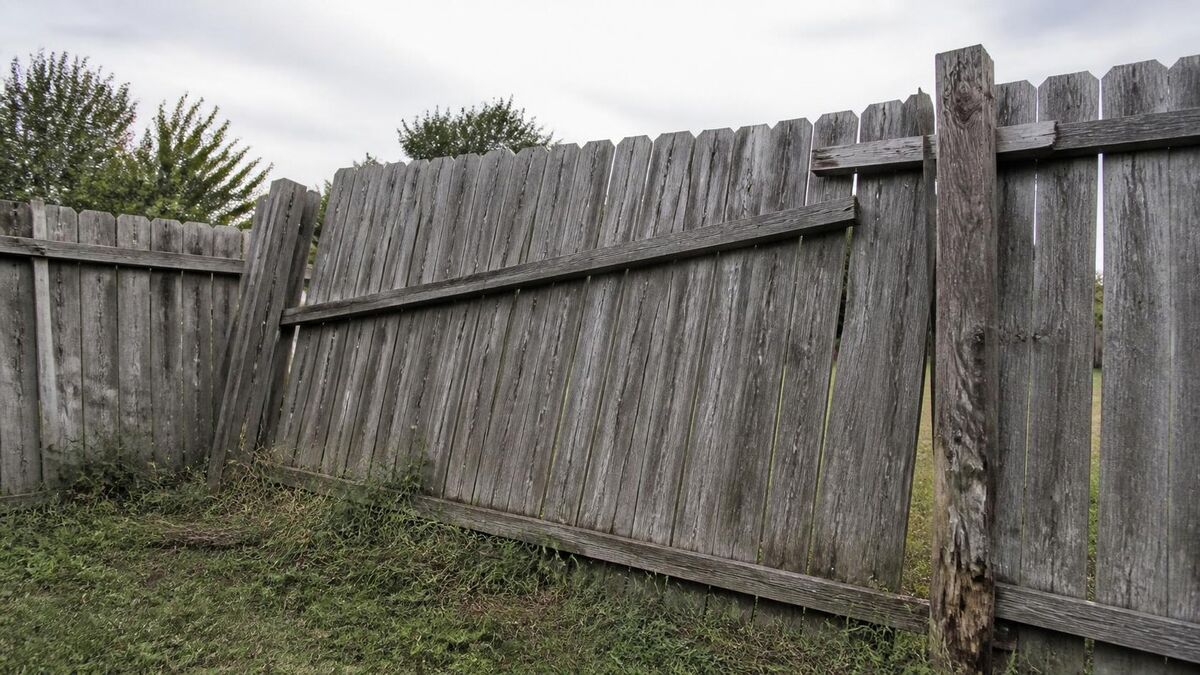
Nearly every repair call traces back to the same three forces. Water is the first. The heavy clay under much of Allen County drains poorly, so the ground around a post can stay saturated for days after a rain, and wood sitting in wet soil decays fastest right at the surface where air, moisture and fungi meet. Frost is the second. A deep northeast Indiana freeze grabs the sides of a post or footing that was set too shallow and lifts it, and the clay rarely lets it settle all the way back. Wind is the third. Flat, open subdivisions with young trees give gusts a long run at a fence, and a solid board face catches all of it.
Rot at the ground line and how a rotted post gets fixed
The telltale sign is a post that looks fine at eye level but flexes when you push on it, or wood that feels soft and spongy when you probe it with a screwdriver just above and below the dirt. Sometimes the post has snapped clean at grade and is held up only by the rails. Concrete footings that were poured flat or domed down toward the post make this worse, because they hold a ring of water against the wood.
If the rails and boards are sound, a rotted post can usually be replaced by itself. The panels on either side are unfastened or supported, the old post and footing come out, and a new ground-contact post is set in a fresh hole with drainage at the base and a crowned top. When many posts on the same run are soft, it is a sign the whole line is near its end, and that changes the conversation.
Frost heave, leaning sections and posts that keep rising
A heaved post shows itself as a top line that is no longer straight, with one post standing higher than its neighbors, or a gate that suddenly will not latch every spring and then works again by summer. Leaning has a few separate causes: a footing that heaved unevenly, soil washed out on one side, a post that rotted partway, or wind pressure working a shallow post loose over many storms.
Simply pushing a leaning post back to plumb rarely lasts. The fix that holds is resetting it: digging it out, deepening and widening the hole so the base sits below frost depth as the local building department sets it for the address, adding gravel for drainage, and setting it again. For a post that is solid but heaved, some contractors cut the footing loose and reset it lower in the same hole. Driven steel repair brackets are a stopgap in clay that moves every winter.
Sagging, dragging and misaligned gates
A gate that scrapes the ground, will not latch, or has to be lifted to close is almost always telling you one of three things. The hinge post has leaned or heaved. The gate frame has racked out of square because it lacks a proper diagonal brace or the brace runs the wrong way. Or the hinges and screws have worked loose in soft wood.
- Loose hinges are the easy case: new longer fasteners into fresh wood, or relocating the hinge slightly, often solves it.
- A racked wood gate can be pulled back square and given a compression brace running from the low hinge corner up toward the latch side, or fitted with a turnbuckle and cable kit as a quicker fix.
- A leaning hinge post is the real problem in many cases, and no amount of hardware adjustment fixes it. That post needs to be reset or replaced with something heavier.
- Vinyl and aluminum gates that sag often have a damaged internal stiffener or loose hinge brackets, and parts are available for many systems.
Broken rails, split boards and missing pickets
Individual parts break from impact, from fasteners rusting through, or from a board drying, cupping and pulling its nails. On a wood fence those are usually quick fixes. Split or missing boards are replaced to match width and thickness, and a broken rail is cut out and replaced, or reinforced with a rail bracket or a short length screwed alongside it. Rails that have pulled away from posts often just need new structural screws or metal rail hangers.
Matching appearance is the hard part. A new board will look brighter than weathered neighbors for a season or more, and treated pine and cedar age differently, so mismatched replacements show. The wood privacy fence page goes into staining and how boards age.
Wind, fallen limbs and other storm damage
Strong storms sweep across northeast Indiana every year, and a solid privacy fence is one of the first things they test. Typical damage includes whole sections laid flat with posts snapped at grade, panels torn off their rails, posts pulled up with the footing still attached, and fabric or panels crushed under a fallen limb.
After a storm, start with safety. Stay clear of anything touching a downed wire and report it to the utility. Photograph the damage from several angles before anything is moved, which helps any claim or conversation with a neighbor whose tree came down. A contractor can then sort out what is reusable: panels in good shape can often be rehung on new posts, while splintered sections are rebuilt to match.
Stretched, torn or bent chain link
Chain link is forgiving and very repairable. Fabric that bellies outward has usually lost tension, often because a tension band slipped, a terminal post leaned or a section was pushed by a dog or a falling branch. Re-stretching with a come-along and fence puller, then re-fastening the tension bar, restores it. Torn or cut fabric can be spliced by unweaving a damaged section and weaving in a new piece of matching gauge and mesh.
A bent top rail is cut out and replaced with a new length joined by a sleeve, and bent line posts are pulled or replaced. Ties holding fabric to the framework rust and snap over time, so replacing the whole set of ties is an inexpensive way to keep fabric from sagging again. More on fabric gauges and framework sits on the chain link fence page.
Cracked, loose or discolored vinyl fencing
Vinyl rarely rots, but it does break. Cold makes PVC stiffer and more prone to cracking, so a snowblower stone, a hockey puck or a fallen limb in January can shatter a picket or rail that would have flexed in July. Rails can also pop out of their post routes when posts shift, and panels sometimes loosen as the material expands and contracts through the seasons.
Repair here is usually about replacing parts rather than patching them. A cracked rail, picket or post cap is swapped for a matching component, which is straightforward when the manufacturer and style can be identified and harder when the system is old or discontinued. Fillers and glue repairs rarely look right or last outdoors. The vinyl fence page explains how quality differs between systems.
Sistering, resetting or replacing a damaged post
Posts are where most repair decisions get made, and there are three basic options with real tradeoffs between them.
- Sistering means fastening a new post or a steel repair stake alongside the damaged one. It is quick and avoids pulling an old footing, but it adds visible bulk and only works when the original post is still mostly sound.
- Resetting means digging out a post that is solid but heaved or leaning, correcting the hole and setting it again, which suits posts with plenty of life left in the wood.
- Replacing means removing the post entirely and setting a new one, the right call for rot, a snapped post or a post too short or undersized for the load.
- On any of the three, the fix should address why the post failed in the first place, whether that was drainage, depth or load, or it will fail again.
Temporary stabilization while a repair is scheduled
When a section is leaning hard or a gate will not close, a short-term fix keeps things safe until a proper repair. A pair of two-by-fours braced diagonally from the post to stakes in the ground will hold up a leaning run. A gate that cannot latch can be tied shut with rope or a bungee so a dog cannot push it open. Loose boards should be removed or screwed down before the next windy day. These measures buy time; they should never be mistaken for the repair itself.
Repair or replace: how to decide on an older fence
A fence is worth repairing when the damage is limited and the rest is healthy. It is worth replacing when the repair would just chase the next failure down the line. A few honest questions sort most cases. The main cost drivers for a repair are the number of posts involved, access to the work, whether old footings must come out, whether matching parts exist, and how far the damage has spread. The contractor sets a price after seeing it.
- Push on posts along the whole run. If only one or two are soft, repair makes sense; if many are, replacement is likely closer.
- Consider the fence's age and whether boards, rails and hardware are tired everywhere, not just at the damaged spot.
- Ask whether matching material is still available, especially for vinyl and aluminum systems.
- Weigh how many times the same section has already been patched.
- If replacement wins, the fence installation page covers the full process.
Getting a fence repair looked at in Greater Fort Wayne
Photos make a repair request much easier to scope. Take a wide shot of the whole fence, close-ups of the damage, and a picture of the base of any leaning or soft post. Then send them with the address through the contact page, and a residential fence contractor working the region can take a look. Repair work comes in from across Fort Wayne-area communities, from older town lots to newer subdivisions.
Fence Repair: questions people ask
Can a leaning fence post be fixed without replacing it?
Often, yes, if the wood is still solid. A post that leans because frost lifted it or the soil washed out on one side can be dug out, set deeper in a wider hole with gravel at the bottom, and plumbed again. If the post has rotted at the soil line, though, straightening it only delays the problem, and replacing that one post is the better use of money. A firm push and a screwdriver probe at the base tells you which situation you have.
Why does my fence gate drag on the ground?
The most common cause is a hinge post that has leaned or shifted, which tips the whole gate down on the latch side. A gate frame that has racked out of square is the next suspect, followed by loose hinge screws. Check the hinge post with a level first; if it is off, the fix is resetting or replacing that post. If the post is plumb, squaring the frame and adding a proper diagonal brace usually brings the gate back into line.
Is it worth repairing an old wood fence?
It depends on how much of it is still healthy. If the posts are mostly firm and the damage is limited to a few boards, a rail or one post, repair is usually sensible. If posts all along the run feel soft at the ground, boards are weathered thin and fasteners are rusting everywhere, money spent on repairs tends to chase one failure after another. Many owners in that position replace the fence and reuse what they can.
How do you fix a fence post that frost pushed up?
A heaved post usually has to come out and go back in. The footing is dug free, the hole is deepened so the base sits below frost depth as the building department sets it, gravel is added for drainage, and the post is reset plumb. Pounding a heaved post back down rarely works in clay and can crack the footing. If several posts heave every winter, the original holes were probably too shallow throughout the line.
Can I replace just one broken section of vinyl fence?
In many cases, yes. Vinyl fence parts, from pickets and rails to whole panels and post caps, can be swapped individually if the system can be identified and matching parts are still made. Older or off-brand vinyl can be harder to match in profile and color, and sun-faded material may look slightly different from new parts. Look for a manufacturer name stamped on a rail or post, or find original paperwork, before requesting a repair.
My fence blew over in a storm. What do I do first?
Keep away from any downed wire and report it to the utility before touching anything nearby. Photograph the damage from several angles before moving debris. Then gather loose boards so they cannot blow into windows or cars, and block any gap so pets or children cannot get through. Panels that survived intact can often be reused once new posts are set, so avoid cutting or breaking them while clearing the area.
Talk through your site
Start with the address, what you want done, and a few photographs of the area, including anywhere water sits after a heavy rain.
Related work
Fence Installation
New residential fences laid out, set and finished for northeast Indiana frost and heavy lake-plain clay.
Wood Privacy Fences
Board-on-board, shadowbox and stockade privacy fences, and what makes wood last through an Indiana winter.
Vinyl Fences
Low-maintenance vinyl privacy and picket fences, and how they hold up in deep cold and open wind.
Chain Link Fences
Galvanized and black-coated chain link for dogs, kids and back property lines.
Aluminum & Ornamental Fences
Ornamental aluminum for front yards, pool enclosures and lots that do not sit flat.
Across the metro
Aboite
Southwest-side subdivisions, wooded lots, lakes and ponds, and association rules on height and style.
Huntertown
Fast-growing north-side neighborhoods on flat, freshly graded lots with slow drainage.
New Haven
An older town grid east of the city plus newer edges, mixed fence vintages and replacement work.
Leo-Cedarville
Larger lots and acreage along the Cedar Creek valley, with long runs, grade and tree lines.